
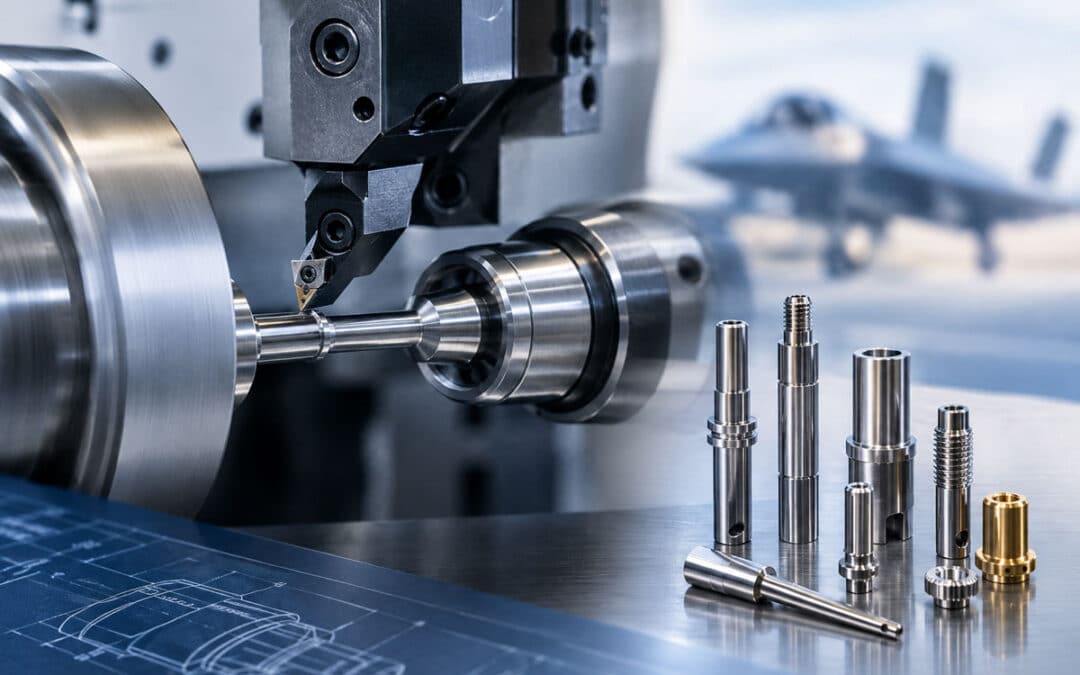
In aerospace and defense assemblies, variation in small, complex components can affect fit, alignment, and performance beyond the individual part. Aerospace Swiss machining provides the precision and repeatability needed to control these critical components across production.
As a precision machining company, MME uses Swiss machining to produce components for demanding aerospace and defense applications. This article examines how the process addresses precision challenges, supports system-level performance, and improves production consistency.
Table of Contents
Where Can Precision Break Down in Small, Slender Components?
Small-diameter components can present significant machining challenges when tight dimensional tolerances must be maintained across a relatively long or slender geometry. As unsupported material extends from the workholding point, cutting forces can contribute to deflection, vibration, and instability. These conditions can make it more difficult to consistently control diameter, concentricity, straightness, geometry, and surface finish.
Swiss machining changes the relationship between the cutting tool and the workpiece by supporting the material close to the cutting zone with a guide bushing. Reducing the unsupported length helps limit deflection as material is removed, providing greater control over critical features. MME uses this process to maintain dimensional accuracy, concentricity, geometry, and surface requirements in pins, shafts, fasteners, and other small precision components where conventional turning methods may provide less stability.
How Does Precision at the Component Level Support the Final Assembly?
The dimensional and geometric characteristics maintained during machining carry directly into the finished assembly. MME’s precision aerospace machining capabilities focus on controlling critical features that influence component interfaces and system performance, including:
- Diameter and geometry: Support proper fit and dimensional relationships between mating components.
- Concentricity and straightness: Help maintain alignment and predictable positioning within the assembly.
- Surface finish: Supports intended contact, movement, and interaction between mating surfaces.
- Dimensional consistency: Helps maintain specified clearances and predictable load transfer between components.
Control over these characteristics becomes particularly important under repeated loading, vibration, temperature changes, and other demanding operating conditions. By maintaining critical features throughout production, MME helps limit component-level variation that could otherwise affect integration and performance within the larger system.
What Role Does Swiss Machining Play in Improving Production Consistency?
Achieving a critical dimension on one component is different from maintaining it across an entire production run. As quantities increase, variation in dimensions, concentricity, geometry, and surface characteristics can create downstream issues with fit, alignment, and assembly. For engineers and procurement teams, process capability matters as much as the precision achieved on an individual component.
MME combines the inherent stability of Swiss machining with inspection and process controls to maintain requirements from component to component. Supporting the workpiece near the cutting zone creates more consistent machining conditions, while quality controls provide verification that critical features remain within specified requirements. Together, these capabilities help reduce variation entering assembly and support more predictable integration across production quantities.
Protect System Performance With MME’s Precision Aerospace Machining
For small, slender, and complex aerospace components, machining precision has implications throughout the finished assembly. Controlling critical dimensions and geometry supports proper integration and system performance, while maintaining that control across production helps limit downstream variation.
MME brings Swiss machining together with engineering, inspection, and quality control capabilities to address these requirements throughout production. Learn more about MME’s precision aerospace machining capabilities and how they can support demanding component and assembly requirements.