
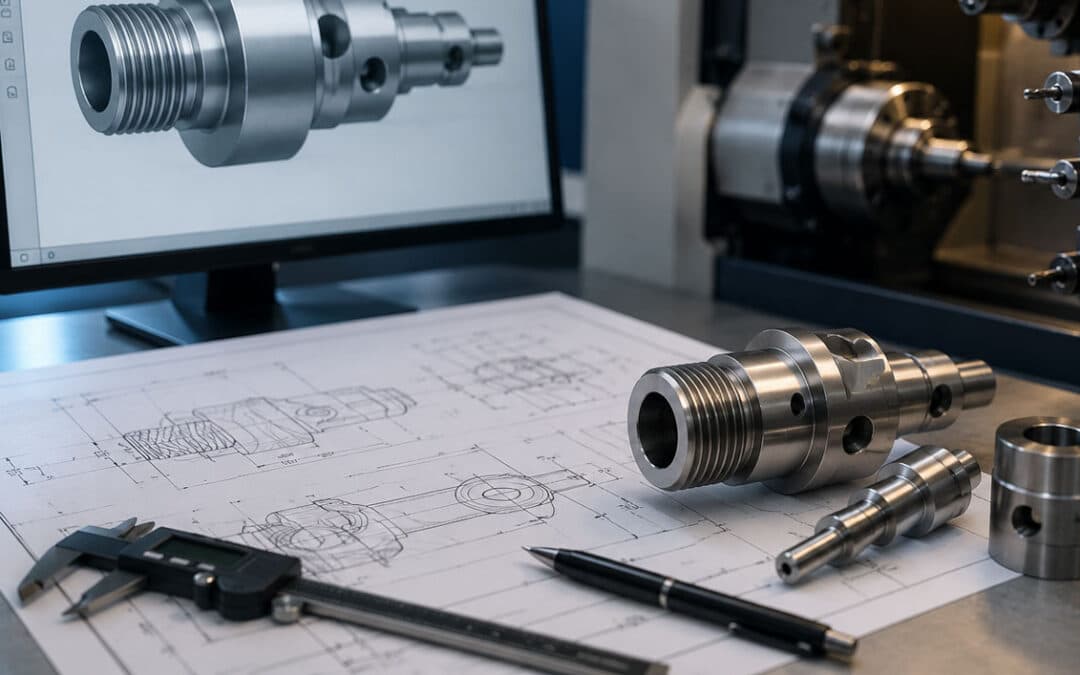
Designing Swiss machined components goes beyond meeting dimensional requirements. The decisions made during the design phase directly influence manufacturability and determine how efficiently and consistently a component can be produced. Many parts are designed without fully considering how they will be supported during machining, introducing unnecessary complexity, longer cycle times, additional setups, and reduced process stability. Together, these factors increase production risk and manufacturing costs.
By addressing manufacturability early in the design process, components can be optimized for the strengths of Swiss machining, resulting in more stable production, improved repeatability, and greater manufacturing efficiency. At Modern Manufacturing & Engineering (MME), we collaborate early in the design process to strengthen manufacturability and support more efficient, repeatable production processes.
Table of Contents
How Does the Manufacturing Process Influence Swiss Machined Component Design?
Swiss machining is capable of producing highly complex, tight-tolerance components, but machine capability alone does not determine production success. Process stability is largely defined by the relationship between component geometry and support conditions as material is removed throughout the machining sequence. By accounting for these relationships during design, engineers can preserve rigidity, maintain dimensional control, and build a manufacturing process that is inherently more stable, repeatable, and cost-effective.
Support Conditions Establish the Limits of Process Capability
Support conditions determine how rigid the workpiece remains throughout machining. As material is removed, the relationship between the guide bushing, cutting tool, and remaining stock changes, affecting dimensional accuracy, surface finish, and tool stability. When rigidity is lost too early, manufacturers often compensate through reduced cutting parameters, tooling adjustments, or additional operations. These adjustments extend cycle times, introduce additional process variability, and increase the likelihood of scrap or rework.
At MME, we design around these support conditions to create a more stable process from the outset. Rather than relying on corrective measures during production, our approach establishes machining conditions that naturally support consistent dimensional control throughout the manufacturing cycle, reducing production risk while helping control manufacturing costs.
Component Geometry Determines How Support Conditions Evolve
Component geometry directly influences how support conditions change as machining progresses. Diameter transitions, length-to-diameter ratios, wall thickness, and grooves all affect the part’s rigidity as successive operations remove material.
Evaluating geometry alongside the machining sequence helps identify where support may be compromised before production begins. Often, relatively small design adjustments improve manufacturability by eliminating unnecessary machining complexity, reducing secondary operations, and preserving stable cutting conditions throughout the machining sequence.
How Can Swiss Machined Components Be Designed for More Efficient Production?
Once geometry has been optimized to preserve rigidity, the next consideration is how features are integrated into the machining sequence. Every operation influences the conditions for those that follow. Designing components around the natural workflow of a Swiss machine helps consolidate operations, reduce handling, and maintain dimensional relationships throughout production.
Feature Sequencing Influences Manufacturing Efficiency
The placement and order of machined features affect far more than cycle time. Critical dimensions are best produced while the workpiece retains maximum rigidity, allowing subsequent operations to build from a stable reference condition. As machining progresses, each operation changes the geometry and support available for the next.
Evaluating feature sequencing as part of the overall manufacturing strategy helps maintain stable machining conditions throughout production. Treating the component as a complete machining process, rather than a collection of individual features, reduces unnecessary tool movement, simplifies programming, and improves consistency.
Consolidating Operations Reduces Process Variation
Modern Swiss platforms combine turning, milling, drilling, threading, and cross machining within a single machine environment. Designing components to take advantage of these capabilities reduces machine transfers, additional fixturing, and repeated datuming that can introduce cumulative variation.
Fewer secondary operations simplify process control, reduce opportunities for dimensional shift between operations, and create a more repeatable and cost-effective manufacturing workflow from the first production run through long-term volume manufacturing.
Why Does Tolerance Strategy Determine Long-Term Production Success?
The goal of tolerance allocation is not simply to achieve the tightest possible dimensions, but to define functional requirements that remain achievable within a stable manufacturing process. An effective tolerance strategy balances component performance with the capability of the process required to produce it.
Tolerance Strategy Should Reflect Functional Requirements
Applying unnecessarily restrictive tolerances across noncritical features increases machining complexity, inspection requirements, and production costs without improving performance. Instead, tolerances should be concentrated around critical interfaces and functional requirements, allowing manufacturing resources to be focused where they provide the greatest engineering value.
Reviewing tolerance strategy during the design phase helps eliminate unnecessarily restrictive requirements that increase machining time, inspection effort, and process complexity without improving functional performance.
Repeatability Is the Measure of a Successful Manufacturing Process
A conforming first article demonstrates that a part can be manufactured. True process capability is demonstrated when that result can be sustained across production volumes. Tolerance strategy plays a central role by defining how much variation each functional feature can accommodate. When tolerances exceed process capability or are applied indiscriminately, variation accumulates and process stability declines.
Aligning tolerance strategy with functional requirements creates a more repeatable manufacturing process, resulting in higher yields, consistent quality, and more reliable long-term production performance.
Improve Manufacturability with MME
The manufacturability of Swiss machined components is established long before production begins. Decisions made during the design phase directly influence manufacturing efficiency, process capability, and long-term production performance.
At MME, we partner with customers early in component development to identify opportunities that improve manufacturability without compromising design intent. By addressing production considerations before they become manufacturing constraints, we help build more stable, repeatable manufacturing processes.
Learn more about our Swiss machining capabilities and discover how early engineering collaboration can strengthen your next manufacturing program.
Frequently Asked Questions
How early should manufacturability be evaluated for Swiss machined components?
Why is process capability important to consider when designing Swiss machined components?
How can feature placement affect the manufacturability of Swiss machined components?
Feature placement influences how a workpiece is supported throughout the machining sequence. Locating critical features where rigidity is highest and planning features around the capabilities of the Swiss machining process can improve dimensional consistency, reduce unnecessary setups, and simplify manufacturing.