
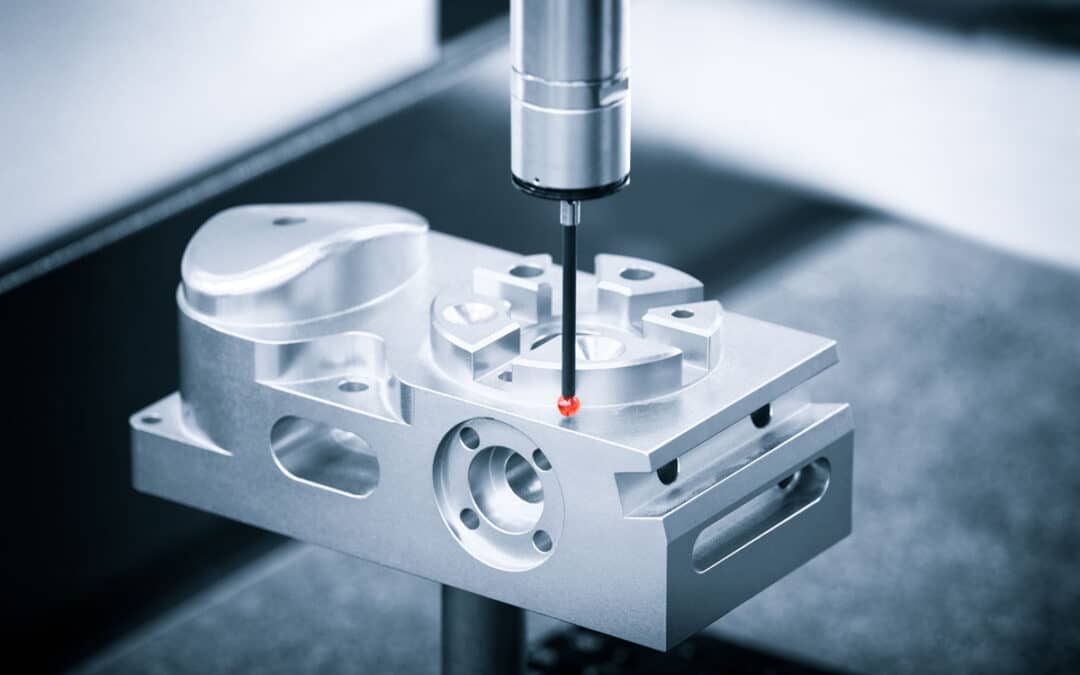
In precision manufacturing, quality is determined by more than machining capability alone. It also depends on the ability to verify that every feature, dimension, and tolerance meets specification throughout production. As part complexity increases and tolerances become tighter, manufacturers need reliable measurement systems that provide confidence in the accuracy of finished parts.
At Modern Manufacturing & Engineering, quality assurance is integrated throughout the manufacturing process rather than treated as a final checkpoint. CMM inspection machines play a critical role in this approach, supporting dimensional verification, process monitoring, and quality control from first-article inspection through production.
This article explores how MME uses CMM inspection machine technology to strengthen manufacturing quality, how the technology fits into its broader quality management system, and how advanced inspection capabilities help support consistent production outcomes.
Why Are CMM Inspection Machines Critical to Manufacturing Quality?
Quality verification requires more than visual inspection. In modern manufacturing environments, dimensional accuracy must be measured consistently and repeatedly to ensure components meet design requirements and perform as intended.
This is where CMM inspection machines become an essential part of the quality process. MME utilizes multiple Hexagon CMM machines with scanning capability to support dimensional verification and measurement consistency across a wide range of components. These systems allow quality assurance teams to gather detailed measurement data and compare results against engineering specifications.
As part complexity and production volume increase, automated verification becomes increasingly valuable. Complex geometries, tight tolerances, and critical features require a high level of measurement consistency to support confident decision-making throughout production. By leveraging CMM inspection machines, manufacturers can reduce inspection variability while improving repeatability and dimensional verification.
How Does MME Integrate CMM Inspection Machines Into Its Quality Process?
At MME, CMM inspection machines are not treated as standalone inspection tools. They operate within a broader quality management system designed to verify dimensional accuracy throughout production.
To support this process, MME utilizes PC-DMIS software and CAD modeling to compare measured features with digital design data and inspection criteria. Inspection data generated by CMM machines provide objective measurements that can be used throughout the manufacturing process to support production monitoring and decision-making.
Rather than waiting until production is complete, MME incorporates verification throughout manufacturing. This approach helps identify potential issues earlier in the process and supports greater confidence in dimensional accuracy as components move through production.
The technology is integrated into several stages of MME’s quality workflow, including:
- First article inspections
- In-process inspections
- Statistical Process Control (SPC) initiatives
- Ongoing dimensional verification activities
What Sets MME’s Quality Assurance Process Apart?
While advanced inspection technology plays an important role, manufacturing quality depends on more than measurement equipment alone. MME’s quality assurance approach combines automated inspection technologies with documented procedures, calibrated measurement systems, and production controls designed to support consistent manufacturing outcomes.
Robust Inspection Technology
In addition to CMM machine capabilities, MME’s quality capabilities include automated optical inspection systems and calibrated measurement equipment for verifying dimensional requirements. Inspection equipment is maintained through established calibration programs to help ensure measurement accuracy and traceability.
Quality Control Touchpoints
Beyond inspection technology, MME incorporates quality planning and process controls throughout production. First article inspections verify initial production runs against engineering requirements, while in-process inspections provide ongoing dimensional verification as parts move through manufacturing. Statistical Process Control (SPC) methods are also used to monitor process performance and identify trends before they affect product quality.
Integrated Quality Assurance
This integrated approach enables a CMM inspection machine to operate within a broader quality management framework focused on continuous verification rather than on final inspection alone. By combining inspection technology, calibration systems, documented procedures, and process monitoring activities, MME strengthens confidence in dimensional accuracy, repeatability, and overall production consistency.
Partner With MME
Manufacturing quality requires consistent dimensional verification and reliable process control. MME’s CMM inspection machines help support these goals by providing accurate measurement data throughout production. Combined with automated inspection technologies, calibration systems, and quality planning, they contribute to a comprehensive quality assurance process.
Learn more about MME’s quality assurance processes and commitment to manufacturing quality.